
Travel Guides
How to Measure a Suitcase Before You Fly

The last place you want to discover that your suitcase is too deep is beside a bag sizer at the gate.
A size label can help you compare cases while shopping, but it is not the whole measurement. Wheels, carry handles and an opened expansion zip can all change the space a packed bag takes up.
Before your next flight, set aside a few minutes to measure the bag you will actually bring. You need a tape measure, a flat surface and your airline's current baggage rules.
Measure the whole bag, not just the shell
Start with the suitcase packed as you intend to travel. Close the main zipper and retract the telescoping pull handle. Leave any expansion section in the position you plan to use.
You are measuring the bag's outside envelope: the space it occupies from one outermost point to the other. Do not run the tape around the curved surface of the shell, and do not stop at the edge of the fabric or plastic if a wheel or fixed handle sticks out farther.
For example, Delta's carry-on guidance lists a limit of 22 × 14 × 9 inches, including handles and wheels. American Airlines also lists 22 × 14 × 9 inches, including handles and wheels, and requires the bag to fit the airport sizer. These are examples from those airlines, rather than a universal carry-on allowance.
Take three separate measurements
Stand the suitcase on a flat floor and check each direction:
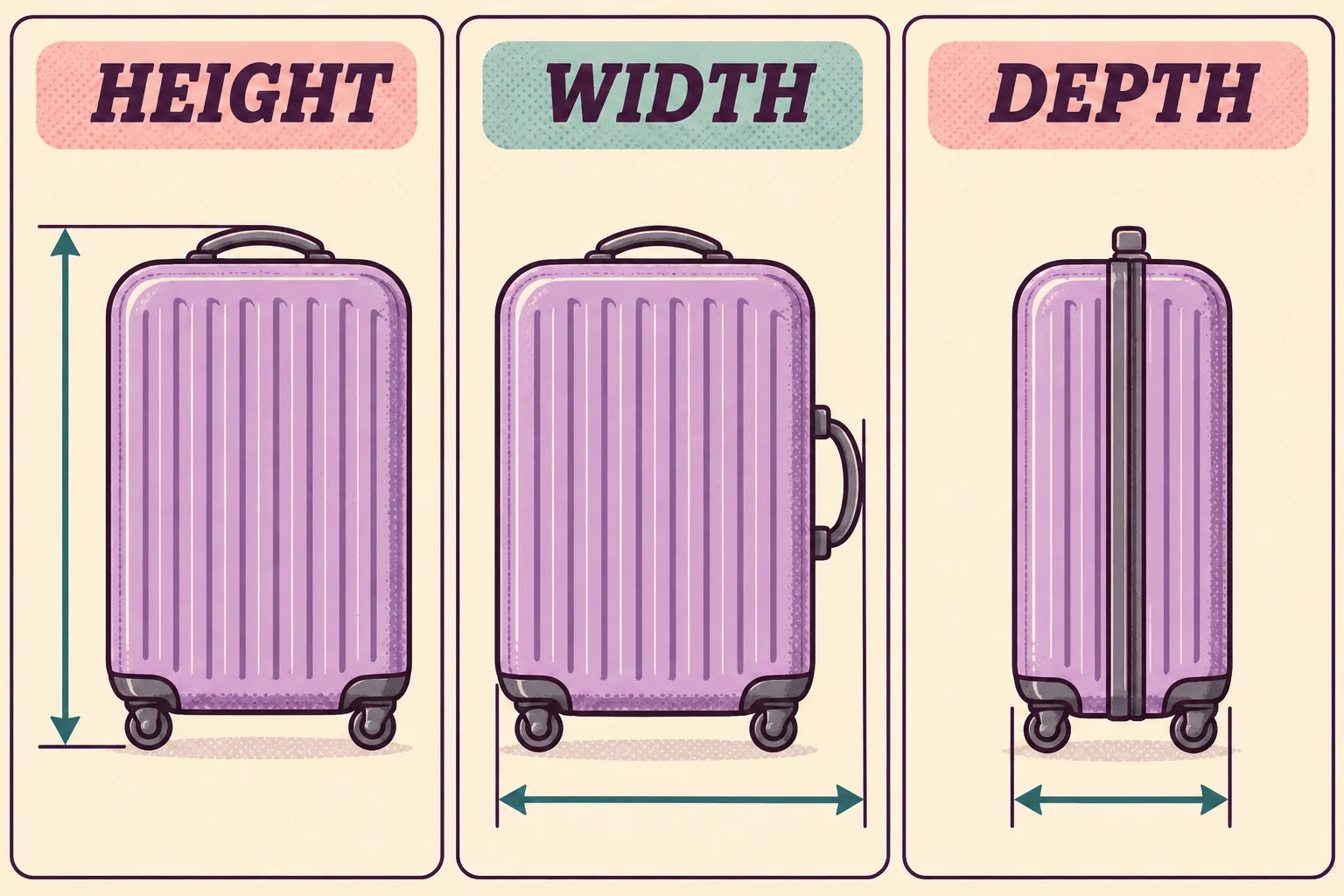
- Height: Measure from the bottom of the wheels to the highest point of the bag, including the fixed top carry handle where it protrudes. Keep the telescoping handle fully retracted.
- Width: Measure across the widest part from side to side. Include a side handle or other fittings if they extend beyond the shell.
- Depth: Measure from the furthest point at the back to the furthest point at the front. Include filled outer pockets and an expanded section, if used.
Rounded edges can make a tape measure awkward to position. Try placing two flat objects, such as sturdy books, just outside the opposite edges you are measuring. Measure the straight gap between their inner faces without squeezing the suitcase.
Write down all three numbers and their units. Keeping a note on your phone is easier than trying to remember whether the last figure was inches or centimeters.
Measure the outermost points, including wheels and protruding carry handles. This illustration shows the method, not a product's dimensions. View the measurement illustration at full size.
An expansion zip can change the answer
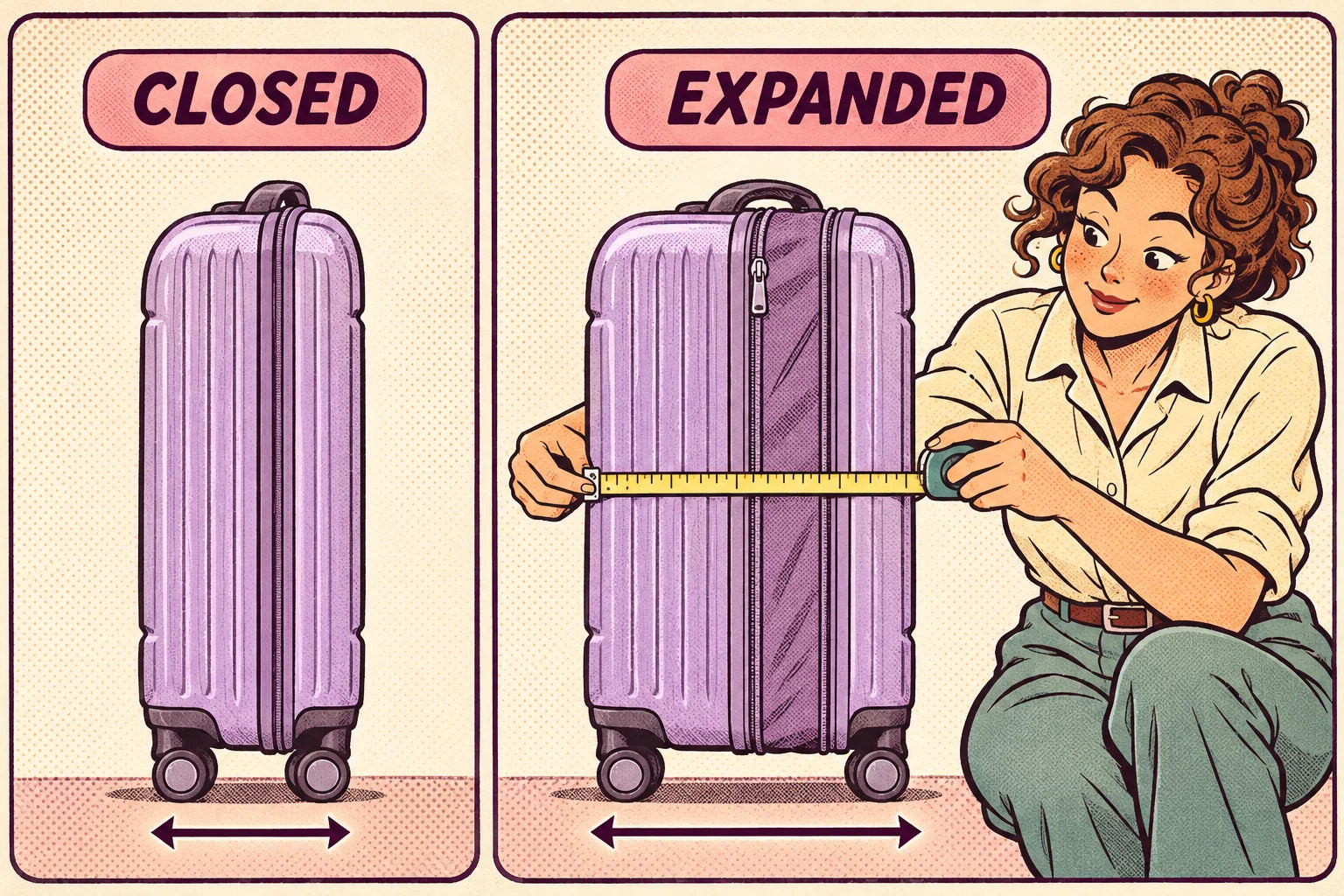
It is tempting to open the expansion section when the packing gets tight. Before you do, check how much depth your airline permits.
If you intend to travel with the case expanded, measure it that way. Measuring an empty, unexpanded case and then adding more room for the return flight gives you a different bag to check against the allowance.
An expansion zipper provides packing space; it does not provide an exemption from baggage rules. This matters on the way home, too, when gifts and souvenirs have joined the packing list.
Compare each number, not only the total
Use the airline's measurements in the order it specifies. If it gives separate maximum dimensions, compare height, width and depth individually.
Here is a hypothetical example, not a LARVENDER product measurement: a bag measuring 22 × 13 × 10 inches totals 45 inches. It would still exceed a 9-inch depth limit. A smaller width does not cancel out the extra depth.
If the airline uses a total-dimensions or linear-inches rule for the type of bag you are checking, add height, width and depth and compare that total with its published limit. Check any separate restrictions it lists as well.
Check the duffel separately
A suitcase and a matching duffel may be sold together, but they still need to meet the rules for the bags you intend to take on board.
Measure a soft bag after packing it, including any bulging pockets. If you want to use it as a personal item, check the airline's personal-item requirements rather than its overhead carry-on allowance.
Our 3-piece vs. 5-piece luggage set guide explains the difference between the number of pieces in a set and the number of suitcases. For a trip with children, the family packing guide can help you decide which pieces to bring.
One last check before departure
Look up the rules for the airline operating each flight on your itinerary. Delta notes that partner flights can have different restrictions, and both airlines linked above describe aircraft-related limits. A bag that meets the published dimensions may still need to be checked when cabin space is restricted.
Weigh the packed bag, too, and compare it with any weight allowance that applies to your booking. Size and weight are separate checks.
When browsing LARVENDER carry-on sets, look for the full exterior measurements of the exact model you are considering. If you only have a nominal size such as “20-inch,” ask for the complete dimensions before deciding whether it suits your flight.
Airline examples checked on November 11, 2026. Follow the current requirements for your own itinerary before traveling.
Travel Guides
A little more for the journey.
Packing ideas, practical tips and stories to take along.

Our story
Color Your Journey: The LARVENDER Way
A soft pastel, an expressive gradient, a set shared across the family. The LARVENDER story starts with choosing luggage that feels like...
Continue reading
Family packing
Packing for a Family Trip: How to Share a 5-Piece Luggage Set
From children's spare outfits to the things you need on the journey, a family packing list takes a little organizing. Here is...
Continue reading
Choosing a set
3-Piece vs. 5-Piece Luggage Sets: What Do You Actually Need?
One suitcase and matching bags, or a choice of three suitcase sizes? Find the luggage set that fits the trips you actually...
Continue reading